
Upright Meaning
This card traditionally shows a choice, attraction and the influence of other people. Its central question is what commitment you will make.
Tarot de Marseille · Major Arcana
L’Amoureux · Major Arcana
This card traditionally shows a choice, attraction and the influence of other people. Its central question is what commitment you will make.
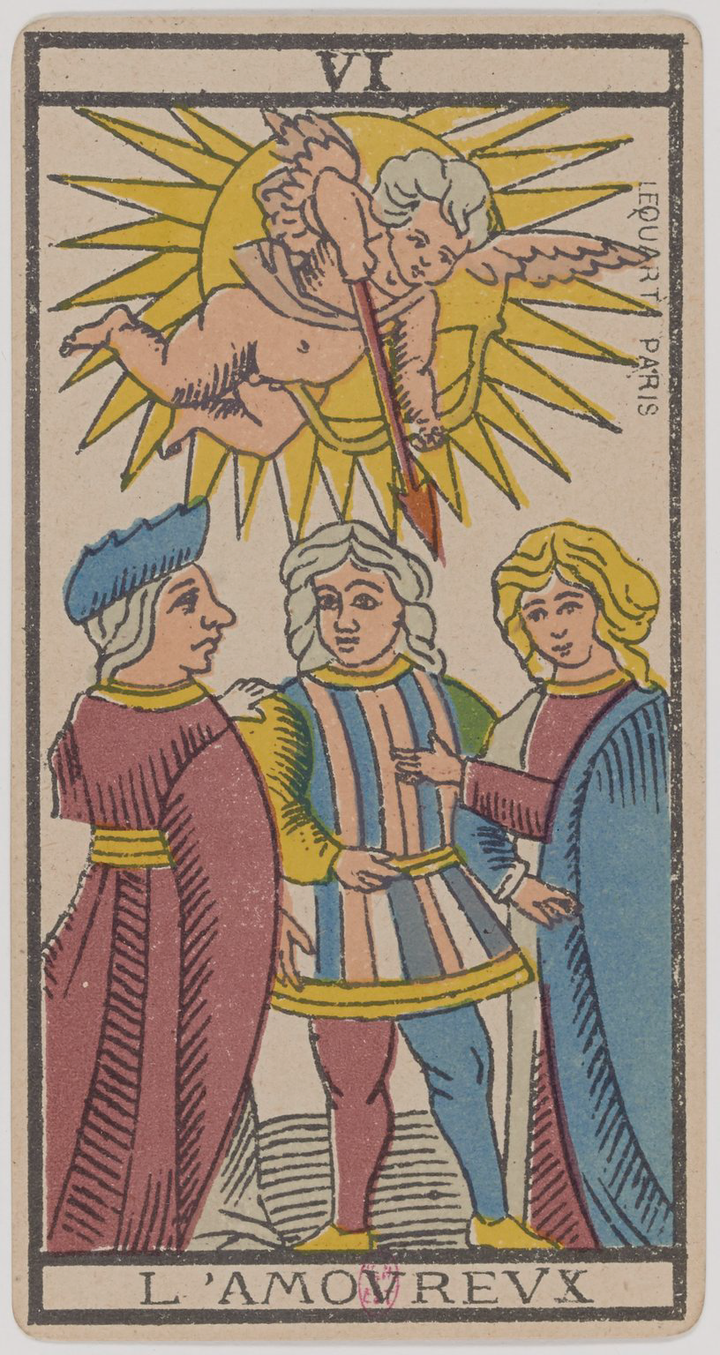
French title: L’Amoureux
Keywords: choice, attraction, values
This card traditionally shows a choice, attraction and the influence of other people. Its central question is what commitment you will make.
Indecision, divided loyalties or choices made to please others can delay honest action. Clarify what you genuinely value.
As a Marseille trump, this card is read through its archetypal image, traditional sequence and relationship to the question.
In relationships, consider the choices, values and patterns that shape the connection. Ask what is being invited, challenged or brought to a turning point.
For work, study or major projects, consider what the card says about direction, responsibility and the wider stage of development.
For personal reflection, consider how this archetype challenges your current way of approaching a situation. What value, habit or choice is being brought into view?
Study the actual Marseille image before importing meanings from a modern illustrated deck. Notice posture, objects, colours, direction and the card's title or number. Marseille imagery has its own visual vocabulary.
Begin with the card's number or archetype, then add the suit or visual detail. Relate that combination to the question and spread position. Consider one alternative reading and test both against real circumstances. A card is a reflective prompt, not proof or a guaranteed forecast.
Practice question: “What part of this situation is changing, developing or asking for a more deliberate response?” This fictional prompt is deliberately open-ended.
Step 1 — Start with the Marseille meaning: This card traditionally shows a choice, attraction and the influence of other people. Its central question is what commitment you will make.
Step 2 — Notice the system: This is a Major Arcana card, so begin with its archetypal image, number and traditional role in the sequence. The keywords choice, attraction, values are prompts, not a checklist.
Step 3 — Test another angle: Indecision, divided loyalties or choices made to please others can delay honest action. Clarify what you genuinely value. A reversal is one possible reading method, not a universal Marseille rule; some readers use upright cards only.
Step 4 — Connect it to life: Begin with the card's number or archetype, then add the suit or visual detail. Relate that combination to the question and spread position. Consider one alternative reading and test both against real circumstances. A card is a reflective prompt, not proof or a guaranteed forecast. Check what is known and avoid claims about another person's private thoughts or guaranteed events.
Step 5 — Write a grounded response: “The theme I want to examine is ______. One practical thing I can observe or do is ______.” Keep the action within your control.
The Tarot de Marseille is a family of historical patterns, not one single immutable deck. This guide uses a Marseille-pattern 78-card image set and modern reflective interpretations. Numbered suit cards are read through pip arrangement, number and suit symbolism; they do not use the same illustrated scenes as Rider–Waite–Smith.
Image source: TarotCards public-domain deck source notes. The source project identifies its Marseille scans as public domain and credits Wikimedia Commons.