
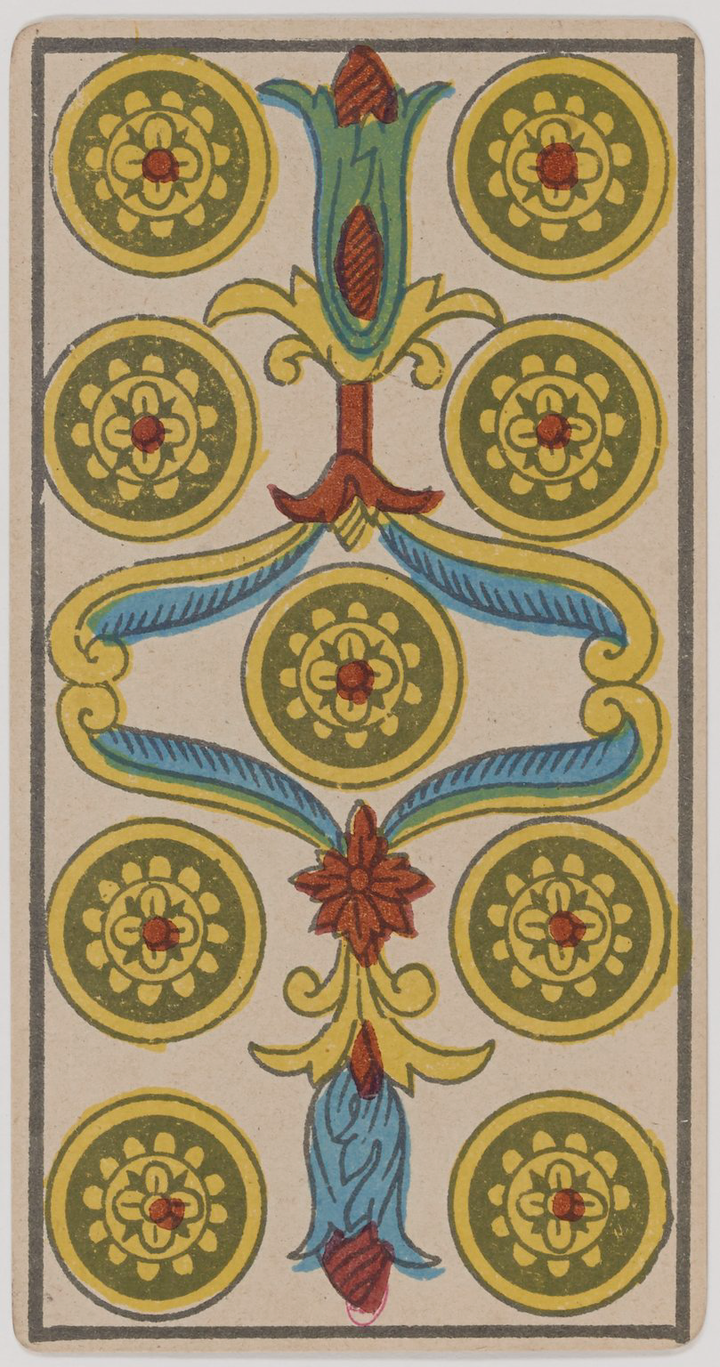
Tarot de Marseille · Pentacles

Nine of Pentacles

Neuf de Deniers · Deniers

In the Marseille tradition, this card combines a strong expression approaching completion with material resources, work and practical life. Experience, independence and nearing a result is expressed through resources, tangible results and security. Consider how this pattern is developing in the practical circumstances of your question.

Neuf de Deniers — Tarot de Marseille card
Tarot de Marseille

French title: Neuf de Deniers

Keywords: a strong expression approaching completion, material resources, work and practical life, resources, tangible results and security

Browse the Marseille deck

Upright Meaning

In the Marseille tradition, this card combines a strong expression approaching completion with material resources, work and practical life. Experience, independence and nearing a result is expressed through resources, tangible results and security. Consider how this pattern is developing in the practical circumstances of your question.

Reversed Meaning

The reversed card can suggest excess, delay or a result that needs rethinking alongside worry about resources or misplaced priorities. Consider whether the card's central pattern is blocked, excessive, delayed or being experienced inwardly.

What This Card Brings Into Focus

Traditional Marseille pip cards are read through the number, suit emblems, visual arrangement and neighbouring cards; unlike Rider–Waite, the numbered cards do not normally depict a narrative scene. The number and suit work together; surrounding cards and spread position help refine the reading.

Love & Relationships

In relationships, look at reliability, shared responsibilities, practical support and whether promises are matched by consistent effort.

Career & Work

For work and money, this suit is closely connected with practical resources, skill, effort and long-term results. Check costs, commitments and evidence before acting.

Personal Growth

For personal reflection, consider how the card's number and suit combine. Notice the stage of development represented by the number and the area of life described by the suit.

Symbolism & Visual Study

Traditional Marseille pip cards are read through the number, suit emblems, visual arrangement and neighbouring cards; unlike Rider–Waite, the numbered cards do not normally depict a narrative scene. Count the suit emblems and observe their arrangement, symmetry, decoration and any central flowers or leaves. The pattern itself can contribute to interpretation.

Practical Advice

Begin with the card's number or archetype, then add the suit or visual detail. Relate that combination to the question and spread position. Consider one alternative reading and test both against real circumstances. A card is a reflective prompt, not proof or a guaranteed forecast.

Worked example: reading Nine of Pentacles in context

Practice question: “What part of this situation is changing, developing or asking for a more deliberate response?” This fictional prompt is deliberately open-ended.

Step 1 — Start with the Marseille meaning: In the Marseille tradition, this card combines a strong expression approaching completion with material resources, work and practical life. Experience, independence and nearing a result is expressed through resources, tangible results and security. Consider how this pattern is developing in the practical circumstances of your question.

Step 2 — Notice the system: Combine the card's number or court rank with the suit. Marseille pip cards are not illustrated as little stories in the Rider–Waite manner, so avoid importing a scene that is not shown. The keywords a strong expression approaching completion, material resources, work and practical life, resources, tangible results and security are prompts, not a checklist.

Step 3 — Test another angle: The reversed card can suggest excess, delay or a result that needs rethinking alongside worry about resources or misplaced priorities. Consider whether the card's central pattern is blocked, excessive, delayed or being experienced inwardly. A reversal is one possible reading method, not a universal Marseille rule; some readers use upright cards only.

Step 4 — Connect it to life: Begin with the card's number or archetype, then add the suit or visual detail. Relate that combination to the question and spread position. Consider one alternative reading and test both against real circumstances. A card is a reflective prompt, not proof or a guaranteed forecast. Check what is known and avoid claims about another person's private thoughts or guaranteed events.

Step 5 — Write a grounded response: “The theme I want to examine is ______. One practical thing I can observe or do is ______.” Keep the action within your control.

Reflection Questions

  • Which detail in this Marseille card catches my attention first?
  • How does its archetype or number-and-suit combination relate to my question?
  • What alternative explanation should I consider before settling on an interpretation?

Reading the Marseille Tradition

The Tarot de Marseille is a family of historical patterns, not one single immutable deck. This guide uses a Marseille-pattern 78-card image set and modern reflective interpretations. Numbered suit cards are read through pip arrangement, number and suit symbolism; they do not use the same illustrated scenes as Rider–Waite–Smith.

Image source: TarotCards public-domain deck source notes. The source project identifies its Marseille scans as public domain and credits Wikimedia Commons.

Return to Marseille card library Try a Marseille reading